

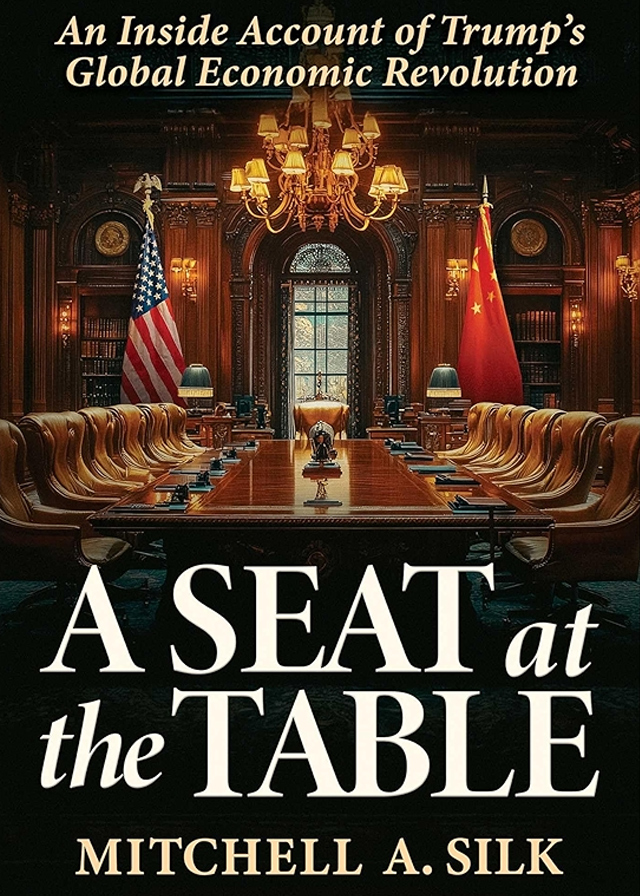
Description
“From the trade negotiations with China to implementing the CARES Act during the pandemic, Mitchell Silk played a critical role during some of the most challenging economic moments in recent history.” —Steven T. Mnuchin, 77th Secretary of the US Treasury
From his earliest beginnings as a dishwasher in a Chinese restaurant to his work in international law and finance, Mitchell Silk’s story illustrates how perseverance and divine providence led him to become the first Hassidic Jew ever confirmed by the Senate for a position in the US Federal government and a consequential leader in Trump’s Treasury.
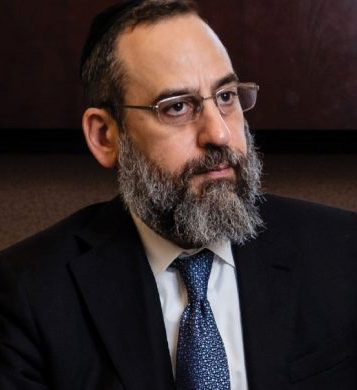
Mitchell Silk served as assistant secretary for International Markets at the US Department of the Treasury, and was the first Hassidic Jew to ever serve in a presidentially-nominated and Senate-confirmed role. His inspirational story is about the providence, perseverance, and personal touch it takes to bring about positive change in the world.
During his thirty-year legal career, Mitchell developed deep expertise in banking, finance, energy, and infrastructure. He advised on many large cross-border capital-intensive landmark energy and infrastructure projects all over the world. As assistant secretary in the Treasury, Mitchell played a senior role in the trade negotiations with China, designed and implemented both the landmark América Crecé initiative and the Trump 45 Administration signature program in the Western Hemisphere that spurred infrastructure growth through private capital solutions in Latin America and beyond, and spearheaded the $94 billion program that saved the airline industry during COVID.
While personal touch and faith in positive outcomes are not often considered de rigueur when it comes to assembling a top-shelf toolkit for international economic policy and diplomacy, they were an essential part of Mitchell’s experience. You will see that good intentions, kindness, and understanding—not to mention a delicious meal shared between friends and enemies—have a unique ability to bridge cultural differences and achieve peace and prosperity.
Neville Teller (verified owner) –
After a career spent in powerful legal advocacy and US government service at the highest level, it seems that 61-year old Mitchell Silk still has to pinch himself to believe he has been able to come so far and achieve so much. He never forgets that his grandfather was born
in a typical shtetl – Nadvorna in western Ukraine – and that he is connected by way of Torah study with Reb Mordecai, the town’s one-time renowned Hassidic scholar. Silk was raised as a Hassidic Jew, has remained so, and became the first to be confirmed by the US Senate for a senior administrative position.
“How did I get here?” he asks himself early on in “A Seat at the Table”, and spends the rest of the book not only providing the answer, but also recounting the details of his outstanding career and his insights into the major issues he was involved in. Yet the sense of wonder at his extraordinary elevation into the highest echelon of America’s governance never leaves him. He returns to it in his Epilogue, where he writes again of his “humble beginnings”.
As in most cases of success in life, luck plays its part in Silk’s story. Silk, however, will have none of it. He knows precisely where responsibility for his good fortune resides. In every phase of his journey, he writes, “I have seen the quiet, steady hand of Divine kindness guiding my steps.” He titles his first chapter: “The good Lord sent me to a Chinese restaurant.”
While still a schoolboy, circumstances led him to an abiding friendship with an immigrant Chinese family, and then to working part-time in their Chinese restaurant. There he acquired a working knowledge of Cantonese, which he later enhanced by studying Mandarin. He thus became proficient in China’s two main languages – and this facility, augmented by his own abilities and his dedication to hard work, opened the door to his wide-ranging career spanning international law and high-level trade negotiations, especially as affecting the US-China relationship. Along the way he made substantial contributions to government policy in general, and also to the Hassidic Jewish community in America.
Silk was in government service only during Trump’s first term. He served from October 2017 until January 2021. But his book embraces also Trump’s return to office, and what he terms the “flurry of executive orders and policy moves” that instantly ensued. He believes Trump hit the ground running because he was working to a plan from the very beginning. Based on his experience of working closely with Trump, Silk is absolutely clear in his own mind that the president has a well-considered approach to the problems that face America. Silk sees it as “focused, strategic and aggressive”.
It was his work during Trump’s first term that helped lay the foundation for the policies, especially in relation to US-China trade and tariff agreements, that the president is pursuing in his second. While playing a significant role in shaping US responses to global economic challenges in general, Silk focused on trade negotiations with China, countering China’s Belt and Road Initiative, and constructing legal frameworks to support infrastructure finance.
Silk provides a fascinating insight into the two years of high-stakes trade talks between the US and China he was involved in. He explains how the idea arose of using tariffs as leverage, and describes the negotiations with the Chinese over intellectual property rights and cyber concerns, leading eventually to the Phase One trade agreement in January 2020.
He explains in some detail the challenges posed by China’s negotiation tactics, and how the US handled predatory finance practices, while aiming for more balanced trade terms.
Using his diplomatic and legal expertise, Silk consistently supported Trump’s policy of promoting US interests by steering policy toward market-driven and transparent practices. He helped foster international partnerships, and provided an alternative to Chinese influence in global development projects.
It is clear that throughout his career Silk kept the common touch. He never sought to disguise his origins or who he was – a Hassidic Jew, with the high moral standards that his upbringing had inculcated in him. His working life exemplifies his emphasis on the value of faith, personal diplomacy, and cultural awareness. His colleagues appreciated him for who he was, and speak of his recourse on occasion to “a timely Yiddish proverb”, “Talmudic wisdom” and “a steady stream of Yiddish quips”.
These attractive characteristics shine through “A Seat at the Table”, which Silk himself describes as a “hybrid: part personal history, part professional growth, part roadmap.” Despite the sometimes complex issues he deals with, Silk writes with clarity and attractive frankness and, as the account flows along, he never loses the reader’s interest and attention. It makes for a wonderful read, and is highly recommended.