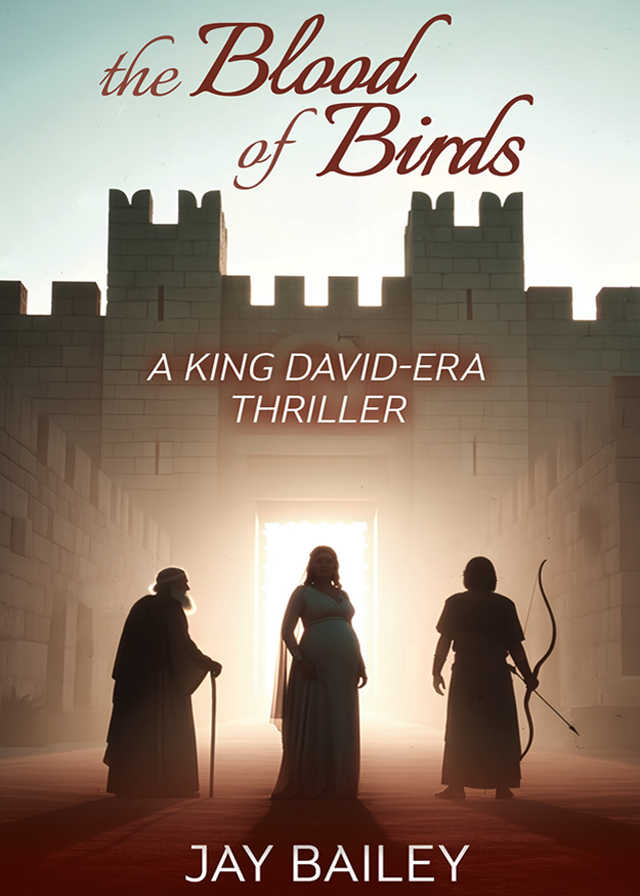
 As their desert wanderings came to an end, the ancient Israelites were instructed to establish six cities of refuge in the Promised Land. Perpetrators of involuntary manslaughter could flee to these cities for protection from “blood avengers.”
Did such cities ever come into reality? We don’t know. But in his debut novel, Jay Bailey imagines how Jewish society in the early days of King David’s reign might have used and/or abused this unique approach to preventing endless blood feuds.
The Blood of Birds brings together Bailey’s interest in historical fiction, biblical archeology, and the history, culture, and geography of Israel, along with his experience in business-oriented storytelling, archeological digs, and tour guiding in Israel, where he’s lived since 1995.
The “birds” in the title of this fast-paced thriller are the characters caged in cities of refuge: unintentional killers; an innocent man framed for an accidental death; a murderer masquerading as a manslaughterer; and the agent of a family bent on revenge.
In the interview below (edited for brevity), Bailey describes the “delicate dance” of creating a compelling contemporary work of fiction within an authentic historical context. Click on www.JayBaileyBooks.com to find out more.
Q: How did your perspective as an observant Jew influence your approach to writing a biblically based novel?
A: Observant Jews believe in the divine authorship of the Five Books of Moses. But we understand that starting from the book of Joshua forward, the material is written by human beings who had agendas, perspectives, and language preferences. As a result, there’s a lot more flexibility in terms of how we interpret the text.
Regarding cities of refuge, we have no documentation at all about one having existed. All we have is a set of rules in Sefer Devarim [Numbers], and then there’s a jump until a brief debate in the Mishna on the minutiae of the regulations. That’s about a thousand years with no mention, no discussion of this topic. Nor do we have a lot of information about day-to-day life in pre-rabbinic, early biblical days in the land of Israel.
So, I didn’t feel I was denying or rewriting or discounting. There’s a lot of latitude for looking at other cultures at the time and what we have learned from archeology and from third-party texts. I simply tried to fill in the gaps where we don’t know.
 Q: What did you learn about cities of refuge in the process?
A: In ancient Egyptian, Assyrian, and Babylonia, an accidental killer could pay off the family or “trade” a relative to get absolution. What I found fascinating is that our version doesn’t allow you to be absolved. You’re accepting responsibility.
I see tremendous value in having a place you could escape to because it wasn’t something you did deliberately, and on the other hand, you can’t easily leave because you’d be at the mercy of the blood avenger.
And then we have this strange rule that when the high priest dies, everybody in the city of refuge goes free. It is a symbolic statement: If your hammer fell and led to someone’s death, it wasn’t a pure accident. Human life is valuable and we’re all responsible for making sure our work practices are safe for society. It’s one of many examples of [how the Torah] elevates a common Middle Eastern notion into something a lot more meaningful.
Q: Did you write for a specific audience?
A: The primary audience I had in mind was a person who feels connected to tradition – Jewish or Christian — and yet does not necessarily have the patience or the interest to pick up the books of Samuel, Kings, Ezra and Nehemiah, which are not particularly entertaining.
I wanted to enable people to step into the world of King David and the Philistines and imagine what life was like for the average person in those times. The book blends the escapism and excitement of a fictional thriller with enough information that the reader comes out smarter.
Because I wanted the book to be “rated PG” and appropriate for schoolteachers to assign for book reports, and for religiously conservative readers, I toned down some of the steamier parts of the original drafts.
Q: How did you balance creativity with historical accuracy?
A: It’s a delicate dance. With every paragraph, I asked myself, “Is this feasible?” Is there a realistic world in which, for example, a shepherd boy could be tinkering with arrows and darts? In the story of Avshalom and Yoav [in 2 Samuel], Yoav threw darts at Avshalom. We don’t know exactly what they were. There are lots of interpretations, so I chose one that was feasible.
In the final stages, I gave the text to five different AI engines and asked them to search for anachronisms in wording and subject matter. I was relieved that there were nearly none. One of the engines found a camel in the text and suggested that I replace the camel with a donkey because we know from archeology that camels appear after the king time of King Solomon, about 100 years after this story.
Q: Are you planning another novel?
A: Yes. The next one takes place during the Second Temple days under Roman rule. It will look at the Essene sect at Qumran, and the mysterious ritual of the red heifer – of course, in a research-based and entertaining way.
(This post contains affiliate links. As an Amazon Associate, this site earns from qualifying purchases.)